
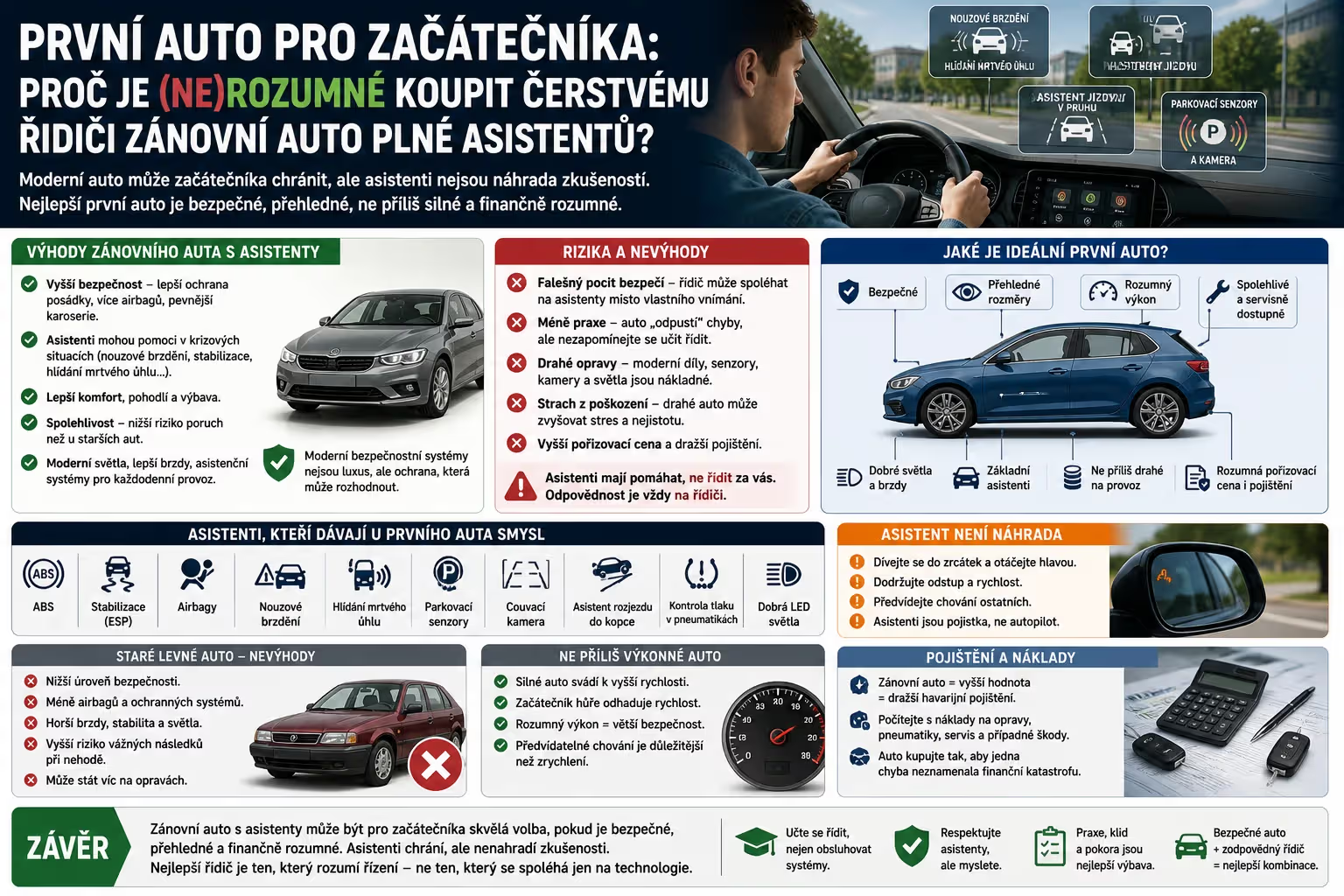
Buying your first car is a big deal. For a new driver, it means freedom, joy, and a sense of independence. For parents or whoever is paying for the car, it’s often a mix of pride, worry, and counting the pennies. Should a beginner get a cheap, older car to “get the hang of driving” in? Or is it better to buy them a nearly new car with modern safety features and driver-assistance systems?
At first glance, a modern car seems like the obvious choice. It has better brakes, airbags, stability control, lane-keeping assist, automatic emergency braking, parking sensors, cameras, and sometimes even adaptive cruise control. But for a beginner, the answer isn’t that simple. A car packed with driver-assistance features can be helpful, but it can also create a false sense of security.
The best first car isn't necessarily the newest or the cheapest. The best first car is one that protects the beginner while also teaching them how to drive.
The old rule: your first car should be inexpensive
It used to be said that a first car should be cheap, simple, and a little beat up. It helps a beginner get used to traffic, parking, the clutch, the car’s dimensions, and common mistakes. If they scratch the bumper or a wheel, it won’t be a financial disaster.
There’s something to that. A new driver really does need practice. Driving school teaches the basics, but real driving only begins after that. It’s only in everyday traffic that you see how a person reacts in a traffic jam, in the dark, in the rain, on the highway, when parking, or under stress.
A cheaper car has one psychological advantage: beginners aren’t as nervous. When they’re sitting in a very expensive car, they might get nervous about every curb and every parking spot. Paradoxically, that might not be helpful.
But a really old and cheap car has safety issues.
The safety of an old car is not the same as that of a modern car
A cheap old car may be simple and inexpensive to repair, but it often lacks features we take for granted today. Fewer airbags, poorer crash performance, weaker brakes, poorer stability, no modern driver-assistance systems, dimmer headlights, and poorer occupant protection.
This is important for beginners. Not because every beginner crashes, but because they make more minor mistakes. They have a harder time judging speed, distance, the width of the car, braking distance, and the behavior of other drivers. A more modern car can be more forgiving in an emergency situation.
Electronic stability control, ABS, high-quality tires, good headlights, and a sturdy body aren’t just unnecessary luxuries. These are the things that can make all the difference.
A nearly new car packed with driver-assistance features: a major advantage, but also a risk
A nearly new car offers many advantages for a beginner. It is safer, more reliable, more comfortable, and often comes equipped with modern driver-assistance features. Automatic emergency braking can help if you fail to notice a traffic jam. Blind-spot monitoring can alert you to a car in your blind spot. Parking sensors and a rearview camera make parking easier. Stability control helps prevent skidding. Better headlights make driving at night easier.
All of that is a benefit.
The problem arises when a beginner starts to think that the car will handle everything for them. The assistant isn’t a second driver. It can’t assess a situation like an experienced driver, may not always correctly identify an obstacle, and sometimes intervenes unexpectedly.
Beginners need to learn how to drive a car, not just how to operate the systems. They need to understand following distance, speed, road surface, weather conditions, mirrors, blind spots, and the behavior of other drivers. Driver-assistance systems are meant to help, not to replace hands-on practice.
A false sense of security
The biggest risk of a modern car for a beginner isn't the technology itself. The risk is a false sense of security.
When a car automatically stays in its lane, beeps while parking, brakes in traffic, and alerts the driver to blind spots, a beginner might become complacent. Instead of learning to check their mirrors, turn their head, and anticipate what’s ahead, they start expecting the car to beep.
That's wrong. A responsible driver uses driver-assistance systems as a safety net, not as a substitute for attention.
It’s similar to using a calculator in school. It’s useful, but first you have to understand math. When it comes to driving, this is even more important, because a mistake won’t result in a bad grade, but in an accident.
The advantage of a modern car: beginners learn in a safer environment
On the other hand, it’s not fair to say that a beginner should drive an old car just to “learn.” No one should have to learn to drive in a car that lacks safety features.
Modern safety systems serve a purpose. When a novice driver makes a mistake, the car can help mitigate the consequences. Automatic emergency braking, stability control, good tires, and high-quality headlights aren’t just gimmicks. They’re safety features.
So a reasonable compromise isn’t to give a beginner a beat-up car with no features. A reasonable compromise is a safe, easy-to-drive car that isn’t too powerful, comes with basic driver-assistance features, but isn’t unnecessarily expensive or complicated.
Not a very powerful car
Your first car shouldn't be too powerful. Power is appealing, but beginners often don't yet have a feel for speed. A powerful car accelerates easily, and you might not realize how fast you're going.
Your first car doesn't have to be sluggish. But it should be predictable. Decent power, a smooth engine, good brakes, and stable handling are better than sporty pretensions.
A powerful car can be safe in the hands of an experienced driver, but it can tempt a beginner to take risks. And that goes for young drivers who think they “already know how to drive” just because they’ve recently gotten their license.
Automatic or manual?
There is no single right answer here.
An automatic transmission is convenient for beginners. The driver doesn't have to worry about the clutch, starting on hills, or shifting gears. They can focus more on the traffic. In the city, an automatic transmission is pleasant and reduces stress.
A manual transmission teaches drivers to be more attuned to their car. Working the clutch, managing RPMs, pulling away, and shifting gears are all good training. Anyone who learns to drive a manual well will find it easy to switch to an automatic later on.
If a beginner will mainly be driving in the city and automatic transmissions are already common in the family, an automatic makes sense. If they need to learn to drive a variety of cars, a manual transmission still has its value.
A large SUV isn't the ideal first car
Many parents feel that a large car is safer. While this may be partly true, a large SUV also has its drawbacks for a beginner. It’s harder to judge the width, harder to park, has larger blind spots, is heavier, and can be more expensive in terms of tires, brakes, and repairs.
Beginners often prefer a compact car with good visibility—something that’s easy to park, has a manageable body, offers decent performance, and isn’t unnecessarily wide.
The ideal first car doesn't have to be a small city car, but it shouldn't be too big for the driver.
An expensive car means expensive mistakes
With your first car, you have to expect minor accidents. A scratched wheel, a dent in the bumper, a bump while parking, a dented door from the parking lot. It might not be anything serious, but it really stings when it happens to an expensive, nearly new car.
Modern bumpers are equipped with sensors, cameras, radar, and painted parts. A minor collision can cost much more than it would for an older, simpler car. An LED headlight can be very expensive. The same goes for a windshield equipped with cameras and sensors.
That’s why it’s not a good idea for a beginner to buy a car that’s at the upper limit of their budget. A car is supposed to be helpful, not to make every drive a source of anxiety.
What features will a beginner really appreciate?
Some driver-assistance features make a lot of sense in a first car:
- ABS,
- ESP stabilization,
- more airbags,
- automatic emergency braking,
- blind spot monitoring,
- parking sensors,
- rearview camera,
- good LED lights,
- hill-start assist,
- Checking tire pressure.
These are features that provide assistance without turning the driver into a passenger.
On the other hand, overly complex semi-autonomous systems can confuse beginners. Adaptive cruise control, lane-keeping assist, and automatic parking are useful, but drivers need to understand when to rely on them and when to take control.
The best first car: safe, easy to drive, and not too expensive
The ideal first car for a beginner should be:
- safe,
- technically reliable,
- good visibility from the driver's seat,
- not very powerful,
- reasonably large,
- with cheaper tires and service,
- with good lighting,
- with simple controls,
- with modern basic driver-assistance features,
- but not unnecessarily expensive.
It could easily be a nearly new car. But it doesn't have to be the most expensive, fully loaded model. Sometimes a three- or four-year-old compact car in good condition is better than a brand-new, expensive car that makes a beginner worry about every little scratch.
Parents shouldn't buy a car based solely on their fears
Parents often want the safest car possible for their child. That’s understandable. But sometimes the focus on safety turns into a drive to buy the biggest, newest, and most high-tech car. Yet a beginner also needs a calm environment, a clear view, and the opportunity to gain experience.
A car isn't meant to be a punishment or a protective cage. It's meant to be a tool that helps new drivers learn independence.
Rather than buying the most expensive car, it makes more sense to invest in additional training. A safe driving course, skid control training, highway driving, parking, night driving, or taking your first long trips together can be more valuable than yet another optional driver-assistance feature.
What about insurance?
Beginners should also consider insurance. A nearly new car has a higher value, so comprehensive insurance makes sense. However, the premium may be higher, especially if a young driver is the primary user.
With a cheaper car, comprehensive insurance isn't always worth it, but you have to be prepared to pay for the damage yourself. With a nearly new car, comprehensive insurance is almost a necessity, because repairs to modern parts are expensive.
When deciding on your first car, you need to consider not only the purchase price, but also insurance, tires, maintenance, repairs, and potential damage.
A nearly new car for a beginner—yes, but with caution
Buying a nearly new car packed with driver-assistance features for a new driver can be a sensible choice—if done right. The car should be safe, but not overly powerful. Modern, but not unnecessarily complicated. High-quality, but not so expensive that every drive becomes a source of stress.
Assistants are meant to help beginners, not relieve them of responsibility. Drivers must learn to look ahead, anticipate, brake, maintain a safe distance, park, and understand traffic. The car can mitigate mistakes, but it shouldn’t always correct them for the driver.
The worst thing is going to extremes on both sides. An old, dangerous clunker isn’t a good way to learn. But neither is a very expensive car that a beginner can’t fully control and is afraid to drive.
Conclusion: The best first car isn't the cheapest or the smartest
A beginner’s first car should protect them, but also teach them. Modern safety features are a great advantage, but they should complement good driving, not replace experience.
A nearly new car can be a good choice for a new driver if it’s easy to handle, reasonably powerful, easy to service, and affordable. Features like emergency braking, stability control, parking sensors, and blind-spot monitoring can be helpful. But the driver must remember that the responsibility still lies with them.
Beginners shouldn't learn to drive in a dangerous car. But they also shouldn't be lulled into a false sense of security by a car that pretends to drive for them.
Post a comment